From Incubator to Exit – The Journey of Envue Technologies
All companies that enter Yuncture’s incubator do so with an idea, a direction, and an ambition to build something that lasts. Some journeys take unexpected turns, while others evolve into something even bigger than initially imagined. Envue Technologies is one of those companies. In the summer of 2025, they were acquired by NanoTemper Technologies GmbH—following a journey that began in research at Chalmers University of Technology, with Yuncture’s incubator as one of several key steps along the way.
A New Generation of Microscopy
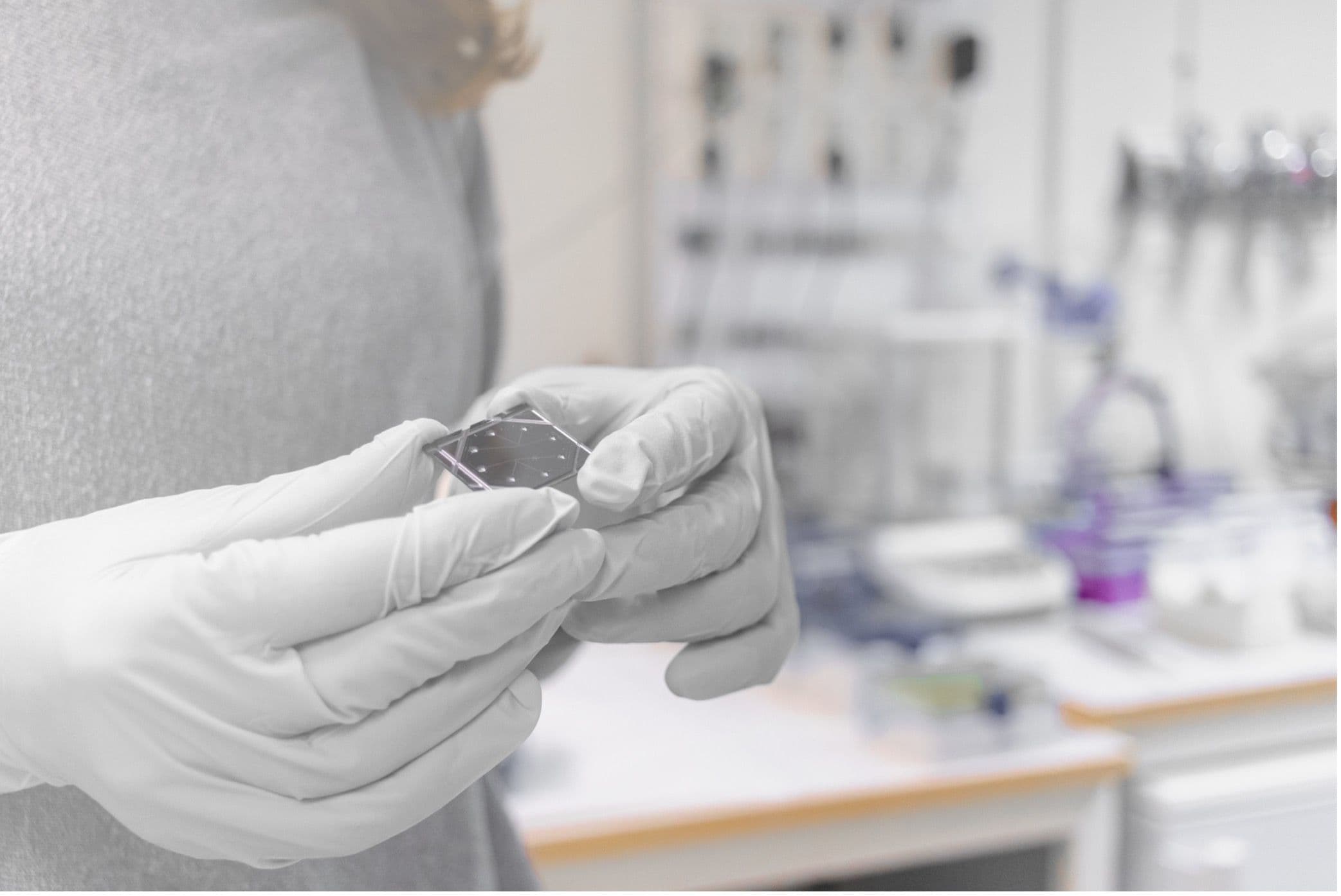
Envue Technologies was founded in 2020 out of physics research at Chalmers University of Technology, in Christoph Langhammer’s lab, with applications in life science. At the core of the company was a new, patented microscopy method—a technology that made it possible to study extremely small objects, biological nano-objects, and biomolecules such as proteins and DNA in a more detailed and innovative way than before.
Unlike many traditional methods, which require samples to be labeled or stained to become visible, Envue could analyze them one by one without altering them—so-called single-molecule and label-free analysis.
It may sound like a small difference, but in the world of research, it’s decisive. Being able to analyze biological samples without affecting them opens the door to more reliable results, with the potential to transform our understanding and how we develop everything from vaccines to new nanomedicines. But the technology itself was only the beginning.
The Big Challenge: What Is the Real Value?
When Envue Technologies entered Yuncture’s incubator, they faced a classic—but difficult—challenge. They had an advanced technology, but needed to understand what problem it could actually solve, and therefore what concrete and measurable customer value it created.
“We had a method and were trying to find a problem to solve with it,” says Ellen, who led the company.
What followed was an intense journey of customer dialogues with researchers in both industry and academia, to understand where the technology could make the biggest difference—and for whom. At the same time, another key question emerged: how do you package the technology into a viable business? Should they build an add-on for existing microscopes, or develop a completely new instrument?
In the end, they chose the latter—creating their own system, including hardware, software, and a nanochip as a consumable. A more complex path, but one that best matched how users work and offered the greatest potential from a business model perspective.
On the Time in the Incubator—and What Came After
For Ellen, the time in the incubator was also a personal journey. With a background as an MSc in Biotechnology, she initially lacked both experience and a network within entrepreneurship.
“I wanted to learn how to build a company and be surrounded by other entrepreneurs,” she says.
The focus was on moving from technology to business: making the offering concrete and shaping a clear investor narrative. Translating advanced technology into something that can be understood, explained, and sold is a process—and a challenge—that many deep-tech companies recognize.
After the incubator, Envue Technologies faced its next critical decision. Developing an advanced instrument requires capital. At the same time, the market was uncertain—especially after COVID-19 pandemic—with shifts in the development and direction of vaccines and nanomedicine.
They mapped out possible paths forward: raising venture capital, returning to research, or finding a strategic partner and potentially selling the company.
Ellen explains that key stakeholders—co-founders, owners, and investors—agreed that an exit with the right partner would be the best outcome for the company. At the same time, it was seen as the least likely option, given that the company was still in an early stage of development. Despite this, they chose to pursue the least likely path: an exit.
A Meeting That Became Decisive
Even before the decision was made, Ellen had been in contact with one of the founders and the then Executive Chairperson of NanoTemper Technologies GmbH via LinkedIn. What started as an informal online conversation developed into something more.
“I immediately felt there was a strong alignment in how we view company building, values, and vision,” she says.
Once the decision to explore a sale had been made, the contact was resumed—and from there, the process moved quickly.
Why NanoTemper Technologies GmbH?
NanoTemper Technologies GmbH is a globally established company in advanced bioanalysis instruments, focused on helping researchers understand biological systems at the molecular level. Through Envue Technologies’s technology, the opportunity emerged to add single-molecule and label-free analysis to its portfolio—something NanoTemper saw as a natural extension of its offering.
But what ultimately made the difference wasn’t just the technology—it was also the shared values. Both companies were driven by a common ambition to contribute to the development of the medicine of the future, particularly within biological nanomedicine, which has gained significant traction following the COVID-19 pandemic.
“We shared the vision that the technology should actually reach the market and make a real impact—while also strengthening Europe’s competitiveness and position globally,” says Ellen.
In the end, the deal resulted in NanoTemper acquiring the entire company.
Life After the Exit
Today, none of the founders are operationally active in Envue Technologies, but they remain involved in an advisory capacity and provide ongoing administrative support when needed. Their focus is on transferring technical knowledge and ensuring that the technology continues to be developed and implemented.
For Ellen, the journey has led to a new role as COO of ConScience AB—the company behind the nanochips, founded by Joachim Fritzsche, who is also one of the co-founders of Envue. At the same time, she carries with her valuable lessons from the journey.
“I wouldn’t change anything about the Envue journey—but next time I take on something similar, I would start by clearly defining what kind of company we’re building and where we’re heading, and make sure both the team and the ownership structure are aligned to get us there through every milestone.”
When we ask what lessons she would pass on to other entrepreneurs, the answer comes quickly. She’s convinced that building a network early is absolutely crucial—in her case, it led to both mentors and an exit. So don’t be afraid to be visible at events and on platforms like LinkedIn. Having people around you who can help you navigate is essential.
A Journey That Continues
The journey of Envue Technologies is, in many ways, far from over. The technology lives on—now with the resources and global reach required to truly enter the market. And perhaps that’s the essence of a successful exit. Not just selling, but giving what you’ve built a greater opportunity to make a real difference.